Takeaways from MOAT 2026
Summary
Lineup Ninja co-founder Joe Atkinson reflects on key takeaways from MOAT, a peer-to-peer event for conference content leaders focused on operationalising AI. From the rising value of human connection to the changing shape of event tech vendors, Joe shares how the day shifted his thinking on AI’s role in the future of conference management and production.
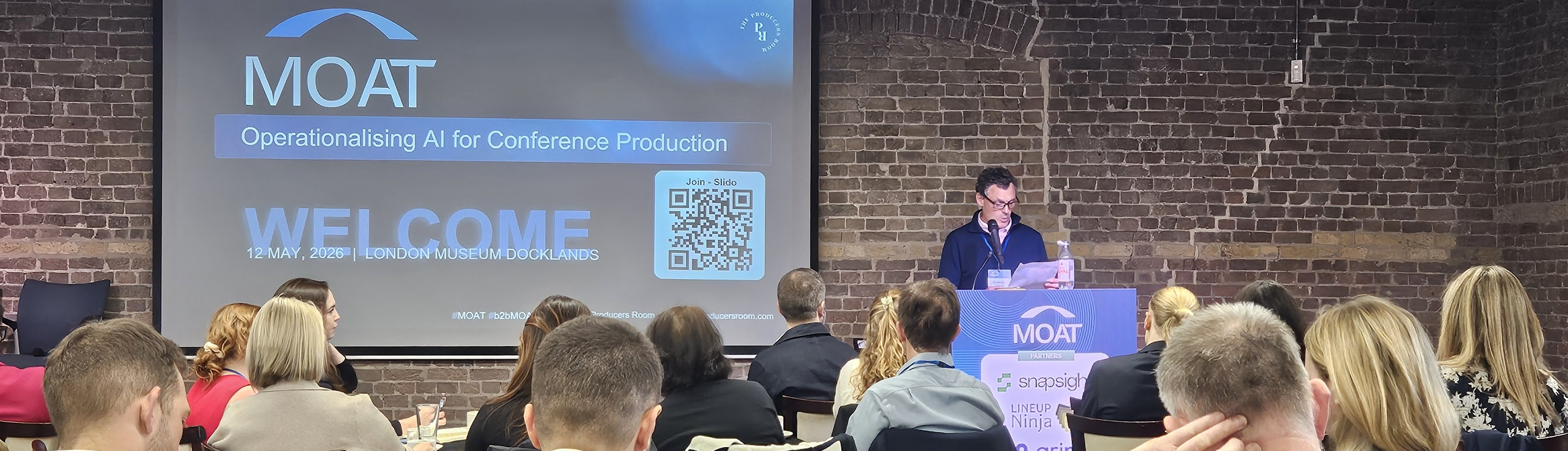
A few weeks ago, MOAT brought together a room full of conference producers and event leaders for a single, practical purpose: to move the conversation about AI in events beyond the hype and into the how.
Organised by The Producers’ Room, the one-day event focused on operationalising AI for conference production. Speakers shared real experiences from event teams already putting these tools to work.
Being so close to the conference organiser community ourselves, we wanted to understand what’s really happening on the front lines of conference and event management, and MOAT delivered.
As all event organisers know, the real value for attendees lies in what content sticks, what causes a shift in thinking, and what attendees find themselves still mulling over days or weeks later.
With that in mind, we asked Lineup Ninja’s co-founder Joe to take some time to reflect on his takeaways from MOAT. Here’s what he had to say.
Joe’s takeaways
“It’s been a few weeks since MOAT, and I’ve had a lot of conversations about AI and events since alongside some of my own experimenting with AI tools inside Lineup Ninja, plenty of reading and quite a bit of reflection. A few themes have stuck with me from the brilliant speakers and conversations with fellow attendees.
AI slop is making the human premium more valuable
As generative AI floods the internet with content, what happens in-person becomes more valuable, not less. Authenticity, timeliness and the simple fact of being there in the room are things AI simply can’t replicate.
That’s a real opportunity for event organisers. We can move beyond the passive “sage on the stage” model of content delivery and start designing genuinely interactive, learner-centred experiences. The bar for what makes an in-person event worth attending is rising, and that’s a good thing for the event industry.
AI will change roles more than it eliminates them
There was a strong sense at MOAT that the productivity gains from AI will let conference producers spend less time behind the AV desk and more time building relationships within their industries and communities.
The producers who do this well won’t be valued for their AI skills directly but instead for the human relationships those skills free them up to build.
That said, it’s not all smooth sailing. In other roles, AI seems to be making people more productive but also more cognitively stretched. Orchestrating multiple agents means constantly framing problems clearly enough for AI to act on them, which takes real mental effort.
The days of coasting through an easy task list on an off day might be numbered. Instead, we’ll be optimising prompts and engineering context for our agents.
AI is reshaping the event tech landscape, for vendors and organisers alike
One thing that really struck me: the barrier to entry for building event tech has dropped dramatically.
That cuts both ways. We could see more vendors offering similar products, which might mean more choice for organisers but also more confusion. Increased competition could trigger price wars, which is good news for event budgets in the short term, but potentially risky if it leads to vendor failures further down the line.
At the same time, organisers themselves are starting to build their own tools and automations. It’s exciting, but it raises real questions about systems architecture, data security and whether the time saved actually outweighs the time needed to maintain what you’ve built.
The pace of change makes it hard to commit
I’ve been tinkering with various generative, source-grounded and agentic tools, but the technology is evolving so quickly that I’m wary of investing too heavily in any one platform or approach. It’s a strange position to be in. I’m wanting to get started, but knowing that whatever you build today might look very different in six months.
We’ll probably stop talking about “AI” as one thing
This is more of a gut feeling and personal opinion, but as AI becomes embedded in more tools and we get more sophisticated about what it actually does, I think we’ll stop using “AI” as a catch-all term. We’’ll talk about the specifics such as facial recognition, agents and so on. The AI part will simply become assumed.
The mixed feelings are REAL and VALID
One of the most honest moments at MOAT was acknowledging the genuine cognitive dissonance many people feel. AI promises huge productivity gains, but it can also feel like an existential threat to roles and businesses. Organisers are motivated by curiosity and excitement, but also by fear of falling behind, all the while wrestling with legitimate concerns about ecological impact, intellectual property and the impact on jobs.
I believe it’s worth sitting with that tension rather than dismissing it. It’s not irrational. It’s a fair response to a genuinely complicated moment.
We still don’t know what actually pays off
Concerns about accuracy and reliability haven’t gone away. Human-in-the-loop oversight is still necessary for most tasks, which limits some of the promised efficiency gains. And all of this is happening while AI remains heavily subsidised; the true cost of these tools on the event budget, once that subsidy disappears, is still an open question.
Final thoughts
MOAT didn’t offer easy answers and at times felt uncomfortable, and honestly, that’s what made it valuable. It was a room full of people thinking carefully about a genuinely complex shift in the events industry - one that affects roles, vendors and the shape of events and conferences themselves.
For us at Lineup Ninja, conversations like these really matter. Understanding how our customers and partners are thinking about AI helps us build tools that genuinely support content teams, rather than adding to the noise. If you were at MOAT too, we’d love to hear what stuck with you and if you weren’t, keep an eye out for the next one!